1157 results prev 1 2 ... 38 39 40 41 42 43 44 45 46 47 ... 57 58 next
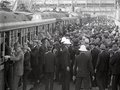

Central Square (1928)
From an elevated position above Central Square (now Railway Square) in Sydney, the camera films the bustle of the streets at rush hour where people transfer from trams to trains and suburban trams to take them out of the city. ... [read more]

The year in review (1971)
This clip includes scenes of anti-apartheid demonstrations against South African sporting teams; John Gorton’s tour of Vietnam; William McMahon becoming Prime Minister; a wool fashion parade staged in the New Guinea Highlands; an unusual wedding celebrated underwater at Sydney’s Marineland; ... [read more]
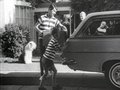
‘Saturday kind of car’ (1967)
A paperboy delivers the Saturday newspaper in a suburban street. A man in his pyjamas waves to his wife as she leaves to do the weekly grocery shopping, taking her daughter and the family dog with her in the Holden ... [read more]
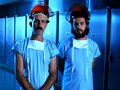
Death at first sight (1988)
Workers in the funeral industry describe their reactions the first time they saw a dead body. [read more]

Six o’clock swill (1976)
Caddie has taken a job in an inner-city hotel, because it pays more than waitressing, but she’s unprepared for the brutal struggle that is the nightly ‘six o’clock swill’. Men crowd the bar to drink as much beer as possible ... [read more]

Life stages of the lobster (1998)
Shows the early life stages of a lobster: thousands of eggs hatch into larvae, which struggle to survive ocean currents for over a year before returning as juvenile lobsters. [read more]

Meet the Squander Bug (1945)
This animated propaganda film from 1945 was used to persuade Australians to invest their savings in the national war chest. The Squander Bug, complete with a large stomach covered in swastikas, is told by Hitler 'Make them waste their money. ... [read more]

A new life in Australia (2004)
Channa Dassanayaka is from Sri Lanka and came to Australia when his mother, who was a politician, thought that things were becoming too dangerous in Sri Lanka and sent Channa to Australia for his safety. When his mother died, he ... [read more]
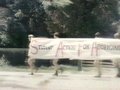
Children join the bus (1993)
Young children in Moree are given permission to go to the swimming pool with the university students led by Charles Perkins. The children scramble onto the bus, and begin to sing a contemporary popular song. On the bus, they are ... [read more]
‘Have you ever met an Aboriginal [person]?’ (1993)
Black-and-white historical interview footage gets the response of white folk to Aboriginal people. The footage, shot on city streets, and in homes of white folk, reveals how they view Aboriginal people. [read more]
Bark burials (1984)
Grahame Walsh explains the sophistication of Aboriginal burial ceremonies and compares them to ancient Egyptian burials. [read more]
Do it yourself (1979)
The Price family has learned to be incredibly self-sufficient. They make their own bread and even cut fence posts from timber on the property. We’re witnessing the pioneer spirit still alive in the second half of the 20th century. [read more]

‘This is a black country’ (2005)
Greg tells us that there is no such thing as an Aboriginal person. There are Waddi Waddi, Gubbi Gubbi, Warlpiri, but the Aboriginal person does not exist. He offers an explanation of the necessity to strengthen blood ties. [read more]
Telegraphists spread the news (1913)
The intertitles at the beginning of this clip explain it all: ‘Telegraphists at work sending the news to Sydney. 200 words a minute. A record’. [read more]

‘Swimmin’ … that’s for white fellas’ (1996)
Aboriginal kids cling to the fence that keeps them out of the pool area. In the pool, Koorine (Carrie Prosser) races a young girl (Megan Drury). They talk about being like Dawn Fraser and Esther Williams. Koorine’s friend convinces her ... [read more]

Safe uranium mining (1997)
We see the location of the proposed mine, and a description of the proposed new road, followed by shots of demonstrators against the mine. Phillip Shirvington, CEO of Energy Resources of Australia, the mining company at Jabiluka, says that ... [read more]

Zigzag (1978)
Essie Coffey instructs some young people on how to track animals. They are looking for porcupine tracks, and finally find one. A porcupine never walks straight says Essie, but always walks in a zig zag. They follow the porcupine to ... [read more]

‘I’m telling you the law’ (2005)
Walking through the mining fields, Norman tells us how the old people used to work the fields, but the young people don’t work anymore, and drink too much grog. Norman says that white people arrived with a noodling machine, and ... [read more]

A marriage of cultures (1987)
A brush pushes dots against an all black canvas. Trevor Nickolls tells us about the influences that shape his work. Nickolls refers to the Western machinery and Indigenous cosmology known as the Dreaming. [read more]
Railcar and swimming (1926)
This clip contains two sequences. In the first, a railmotor pulls around a corner and passes by the camera before pulling into a station. Various shots of this scene show different aspects of the station. A second sequence shows a ... [read more]