Australian Screen

Australia’s audiovisual heritage online

Due to copyright restrictions, this video cannot be accessed from outside Australia.

Curator’s clip description

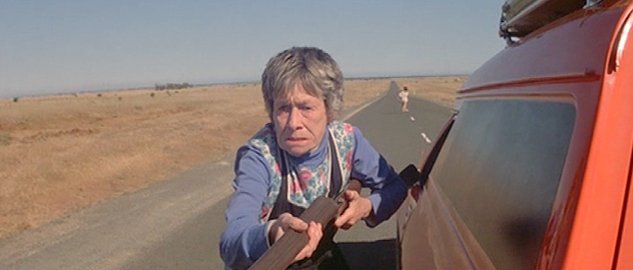
Family friend May Swaisey (Sheila Florance) helps Max’s wife Jessie (Joanne Samuel) and child (Brendan Heath) to escape the Toecutter (Hugh Keays-Byrne) and his gang, but they soon catch up. The scene uses iconic imagery – madonna and child, old lady with shotgun – to generate great emotional power and horror, without becoming explicit in its violence. Killing the mother and child, the worst of crimes, has Biblical overtones.

Teacher’s notes

provided by The Le@rning FederationCurriculum Corporation

This clip shows May Swaisey (Sheila Florance) forcing Toecutter (Hugh Keays-Byrne) and his gang into a shed at gunpoint, as Max Rockatansky’s wife Jessie (Joanne Samuel) and child (Brendan Heath) escape. May bolts the gang in and joins Jessie and the baby in the car. They drive off as the gang starts breaking down the shed door, eventually breaking through to get on their motor bikes in pursuit. The car breaks down and May tries to protect Jessie, firing the shotgun at the approaching gang as Jessie, carrying the baby, runs away barefoot down the centre of the long straight road. The gang passes May and the stationary car, leaving her unharmed. A tachometer on one of the bikes revs, Jessie falls, and the final shot is of a child’s shoe tumbling to the road in the wake of the gang, who disappear into the distance as the roar of their engines fade.

Educational value points

  • The events in the film’s narrative that are shown in this clip led to the creation of one of Australian cinema’s great antiheroes. The death of his wife and child turn Max (Mel Gibson) into Mad Max. His symbolic loss of innocence, hope and decency leaves Max with revenge as his driving force.
  • The clip contains one of the key scenes and most agonising moments in the film. The image of Jessie running down the road has been carefully constructed to intensify the vulnerability of humans in a post-apocalyptic, machine-worshipping age of reckless speed and disregard for life, exemplified by the gang.
  • Director George Miller’s (1945–) skill in creating suspense is clearly demonstrated. The editing, sound, choice of perspective and low-angle shots encourage the audience to experience the approaching gang as a menace. Miller’s ability to horrify the audience while not actually showing explicit violence is masterfully evidenced here when the tiny shoe tumbling across the road suggests the actual impact.
  • Mad Max incorporates elements from a range of genres. In this instance, the scenes have many of the hallmarks of a horror film, including the style of editing, the use of sound, the ways tension and dread are created and the use of narrative set pieces such as the escape of potential murderers from flimsy confinement, the near getaway and the car that breaks down.
  • Women are positioned within the film in traditional and archetypal roles. Characters include the mother and child and the ancient crone. These are figures of heightened vulnerability and have biblical or folk antecedents, which increases their emotional resonance for the audience.
  • The clip provides a convincing rationale for the international success of Mad Max. The intense horror and suspense of these scenes exemplify the grip Miller was able to maintain on his audience. Despite being made on a very low budget and disastrously dubbed for distribution in the USA, the film achieved cult status, ultimately made an enormous impression worldwide and is viewed as a major development in action filmmaking. Miller has continued to work widely in the industry as both a director and a producer, with his directorial work including the next two films in the Mad Max series, Mad Max 2 (1981) and Mad Max Beyond Thunderdome (1985).
  • Mel Gibson (1956–) is shown in the role that catapulted him to international fame. he went on to even greater success as a result of his participation in the second film in the series, Mad Max 2 (1981), and further action films such as the Lethal Weapon series.

Thanks to the generosity of the rights holders, we are able to offer The Toecutter exacts revenge from the feature film Mad Max as a high quality video download.

To play the downloadable video, you need QuickTime 7.0, VLC, or similar.

You must read and agree to the following terms and conditions before downloading the clip:

australianscreen is produced by the National Film and Sound Archive. By using the website you agree to comply with the terms and conditions described elsewhere on this site. The NFSA may amend the 'Conditions of Use’ from time to time without notice.

All materials on the site, including but not limited to text, video clips, audio clips, designs, logos, illustrations and still images, are protected by the Copyright Laws of Australia and international conventions. All rights are reserved.

When you access australianscreen you agree that:

* You may retrieve materials for information only. * You may download materials for your personal use or for non-commercial educational purposes, but you must not publish them elsewhere or redistribute clips in any way. * The National Film and Sound Archive’s permission must be sought to amend any information in the materials, unless otherwise stated in notices throughout the Site.

ANY UNAUTHORISED USE OF MATERIAL ON THIS SITE MAY RESULT IN CIVIL AND CRIMINAL LIABILITY.

This clip is available in the following configurations:

File nameSizeQualitySuitability
madmax3_pr.mp4 Large: 16.2MB High Optimised for full-screen display on a fast computer.
madmax3_bb.mp4 Medium: 7.7MB Medium Can be displayed full screen. Also suitable for video iPods.
madmax3_du.mp4 Small: 1.6MB Low Recommended if you have a slow internet connection, limited storage space, or an older computer. Not suitable for playing full-screen

Right-click on the links above to download video files to your computer.

Copy and paste the following code into your own web page to embed this clip: